
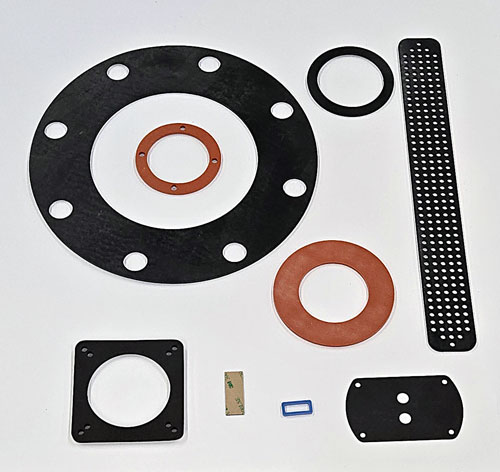
One of the most critical factors in gasket specification is making sure you have the right material for the job. A gasket serves a rather simple but critical purpose: to prevent leaks by providing a reliable seal between two surfaces. But there are many considerations to be made which include temperature, pressure, chemical compatibility and mechanical stress. In this blog, we’ll share the process to guide you when specifying gaskets.
1) Identify The Gasket’s Operating Conditions
The best place to start is by clearly defining the environment where the gasket will be used. Key considerations include:
- Temperature range – will the gasket be subjected to extreme heat or cold?
- Pressure conditions – is the gasket being used in a low-pressure joint or a high-pressure system?
- Media compatibility – listing all of the fluids or gases it will typically be exposed to such as oil, steam, chemicals, water, or air.
- Movement and vibration – will the joint be subject to vibration or other movement?
The better your understanding of these important factors, the easier it will be to narrow down materials that will perform reliably.
2) Know Your Material Options and Their Properties
There are many gasket materials and for good reason. The gasket application will greatly vary from use to use, and there needs to be a material that meets the demands of each one.
Rubber – elastomer gaskets versatile and flexible, and typically used for sealing water, air, and mild chemicals.
- Nitrile (Buna-N) – great for oils and fuels. Moderate temperature resistance.
- EPDM – ideal for water and steam applications, but is not suitable for hydrocarbons.
- Silicone – excellent temperature range and flexibility. Silicone is often used for food and medical products.
- Viton® (FKM) – delivers excellent chemical and heat resistance for more demanding environments
Compressed Non-Asbestos (CNAF) – widely used general-purpose material made from fibers and rubber binders. CNAF provides reliable sealing for water, steam, oils, and mild chemicals.
Polytetrafluoroethylene/PTFE (Teflon®) – specialty material which is ideal for highly corrosive or chemically aggressive environments. PTFE also offers excellent chemical resistance and temperature tolerance. Though PTFE can also creep under pressure, requiring careful design consideration.
Graphite – a highly stable material that withstands high temperatures and pressures. Graphite gaskets maintain seal integrity under thermal cycling. These qualities make graphite ideal for steam and exhaust systems.
Metal/Metal-Reinforced Gaskets – metallic or spiral wound gaskets are used for extreme conditions. These include high pressure and temperature or corrosive environments. Metal gaskets combine both metal, which provides strength, and soft sealing materials. Together, they deliver excellent performance and longevity.
3) Evaluate Costs
It’s always tempting to choose the lowest-cost option, we get it. But understand that selecting the wrong material often ends up causing expensive downtime. The key when selecting the material is to find the balance between performance and cost. We’ve learned that higher-quality materials, although initially more expensive, will typically lead to lower total life-cycle costs. Just keep in mind that it’s better to slightly over-spec than to under-spec.
4) Testing
Testing a gasket in the later part of the development phase is another critical step on your path to gasket success. You must make sure that the material meets performance and quality requirements. We recommend following industry standards to help guide you in this process. These standards include ASTM, SAE, and MIL specs. For the most critical applications, we strongly recommend that you test your prototypes under real-life conditions. Doing so before full scale production will often allow you to solve smaller problems before they grow into huge headaches.
Conclusion
When it comes to choosing the best material for your gasket, please remember that, unfortunately, there’s no one-size-fits-all solution. By carefully considering the important factors we reviewed here today, you can be successful.