
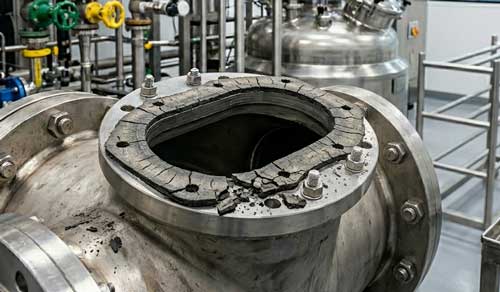
There are many factors that affect a sealing solution’s performance over time. These include material selection, chemical compatibility, compression and pressure, surface conditions, and a few others. But one in particular can have critical implications for the gasket’s ability to do its job: temperature. In this post, we’ll learn how temperature extremes can profoundly affect gasket performance.
Both excessive heat or extreme cold will cause non-metallic gaskets or washers to fail in different ways. Let’s look at the effects each has.
Excessive Heat
When a non-metallic gasket gets too hot, the polymer chains become hyperactive. In other words, molecules start to move very fast, and the material’s internal structure starts to break down as a result. In practical terms, this means the gasket will become brittle and lose its elasticity. Other issues will happen as well:
Compression Problems – over time, the material will permanently deform. It can no longer bounce back, so the seal will gradually loosen.
Fluid Leakage – as the gasket hardens, it shrinks and pulls away from the sealing surfaces. This creates gaps that allow fluid to leak through.
Chemical Acceleration – heat also speeds up reactions between the gasket material and any fluids it comes in contact with. This accelerates material degradation, and the gaskets ability to maintain a proper seal over time.
It’s interesting to note that a gasket doesn’t typically fail immediately when subjected to higher temperatures. For instance, if a material is rated for 200°F and is exposed to 250°, it could take days or weeks for the compression set to increase and elasticity to decrease. But by the time the leak is noticeable, it’s too late. The damage is done.
Extreme Cold
Cold has the opposite effect on a gasket. It causes the material to become inflexible. It becomes stiff, and can no longer properly conform to surfaces, leaving microscopic gaps.
Increased Brittleness – this causes the gasket to be prone to cracking easily if subjected to even the slightest amount of vibration or mechanical stress.
Poor Recovery – when the gasket is compressed and released, it can no longer return to its original shape. As a result, sealing force is reduced and eventually lost.
Seal Failure – cracks and poor contact cause by these issues will create leakage paths, causing the seal to fail.
Gaskets that are subject to extreme cold tend to fail much quicker than those exposed to too much heat. They can fail within days or even hours. Worse yet, since the failure happens much quicker, they tend to be more catastrophic. Things ramp up from zero to a hundred pretty quickly, without the warning signs of a slow leak.
Extreme cold also leads to reduced elasticity, can cause shrinkage, and also make the gasket brittle.
Avoiding Thermal-Related Gasket Failures
The best way to avoid these issues is by making sure you have the right material for your gasket and the application and environment it will be subject to. Every non-metallic material has a temperature operating range associated with it. So it’s important to make sure you have a full understanding of the highs and lows. It’s important here not to look at averages – but to design for the extremes. Know your spikes and cycling patterns. If anything, pad those numbers a bit so you are fully covered. This is a case where small margins make big differences. Getting it right means you’ll avoid most temperature-related failures.
Are you dealing with failed gaskets or washers due to heat or cold issues? Maybe you’re not sure what’s causing the problem? Reach out to our application engineering team, we’ll be happy to help you select the right material for your demanding gasket and washer needs.